Ta-da - our antique indigo furoshiki panel FINALLY hangs in the living room;).
It involved a trip to Michael's (not my favorite - visual overload) for some bamboo lengths, using a hacksaw for the first time in my life... and making some simple loops with indigo-dyed sashiko thread:
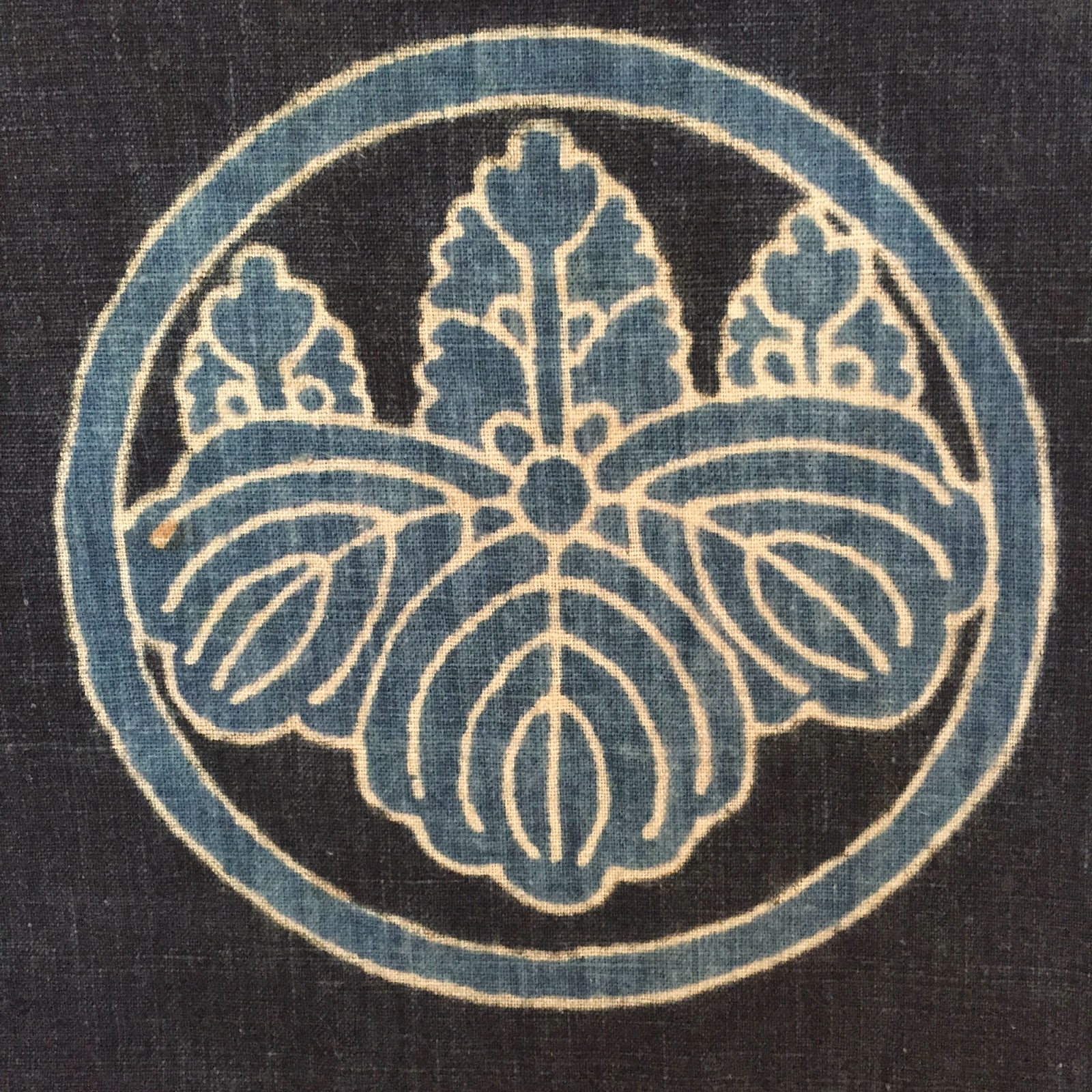
This crest is the one used by David's Japanese ancestors:
I recently wrote about this piece here. That was back in March and I guess I really procrastinated actually hanging this thing up!
It's about as wabi-sabi as it gets, and I just love it.
Today I also put my sashiko table runner back into the dining room:
And picked some peonies in the garden -
That scroll in the background is by Allan West - a brilliant artist and kindred spirit from our time in Japan - and is another treasure - in it he depicted peonies in a most beautiful way.
Today I also did some quilting, but did not take any photos of that. More on that soon!
I hope my quilting buddies near and far are heading into a nice weekend!
xo
Cynthia
Showing posts with label three friends of winter. Show all posts
Friday, June 12, 2015
Tuesday, March 17, 2015
Sho Chiku Bai - three friends of winter
Here is one of the absolute treasures I brought back with me from Japan.
It is a vintage furoshiki, resist- dyed with a traditional Sho Chiku Bai (three friends of winter) motif. The indigo has held up beautifully - the persimmon dye has faded.
Matsu (pine) remains green all winter and beautifies the landscape. It denotes endurance and longevity, inner strength and resistance to hardship:
Take (bamboo) grows quickly and bends, but never breaks, during harsh conditions. It too represents endurance and strength, as well as flexibility:
Ume (plum) blossoms appear at the end of winter, signaling the approaching Spring. They represent hope, vitality, beauty, optimism:
I was with my Japanese sashiko buddies when I found it, so I have that nice memory attached to it too. They explained that it would have been used to wrap up a "lucky" offering of rice for a family who had perhaps just welcomed a new baby. What a beautiful idea, so much symbolism and so many good wishes wrapped up in the three friends of winter.
And.... another very special thing about this piece is the inclusion of the "maruni gosan no kiri" kamon (family crest) - because it is the very same family crest of my husband's paternal ancestors!
Here are the notes I took when I researched this particular kamon:
Kiri = plant
Gosan = 5-3 (five/three flower combination)
Maruni = a circle around
And here is the crest etched on David's paternal ancestors' grave marker:
There are many kamon variations based on the Paulownia tree - the Empress tree. I used a similar kamon in my sashiko sampler:
![]() |
| paulownia kamon |
Legend holds that the Paulownia tree is sacred because it is believed that a Phoenix dwells in the tree. The Emperor gave this crest to the family of Shogun warrior Hideyoshi Toyotomi (1537-1598).
Later in the Edo era, commoners started using crests. Many chose this crest because Toyotomi was a commoner who became a Shogun. David's ancestors were farmers in the Hiroshima area.
All these months, I've been trying to decide how and where to display it, whether to line it first, etc. Today I finally at least got it out, washed and line-dried it, and just starting thinking about it again.
Oh.... how I do love indigo...!
Subscribe to:
Posts (Atom)