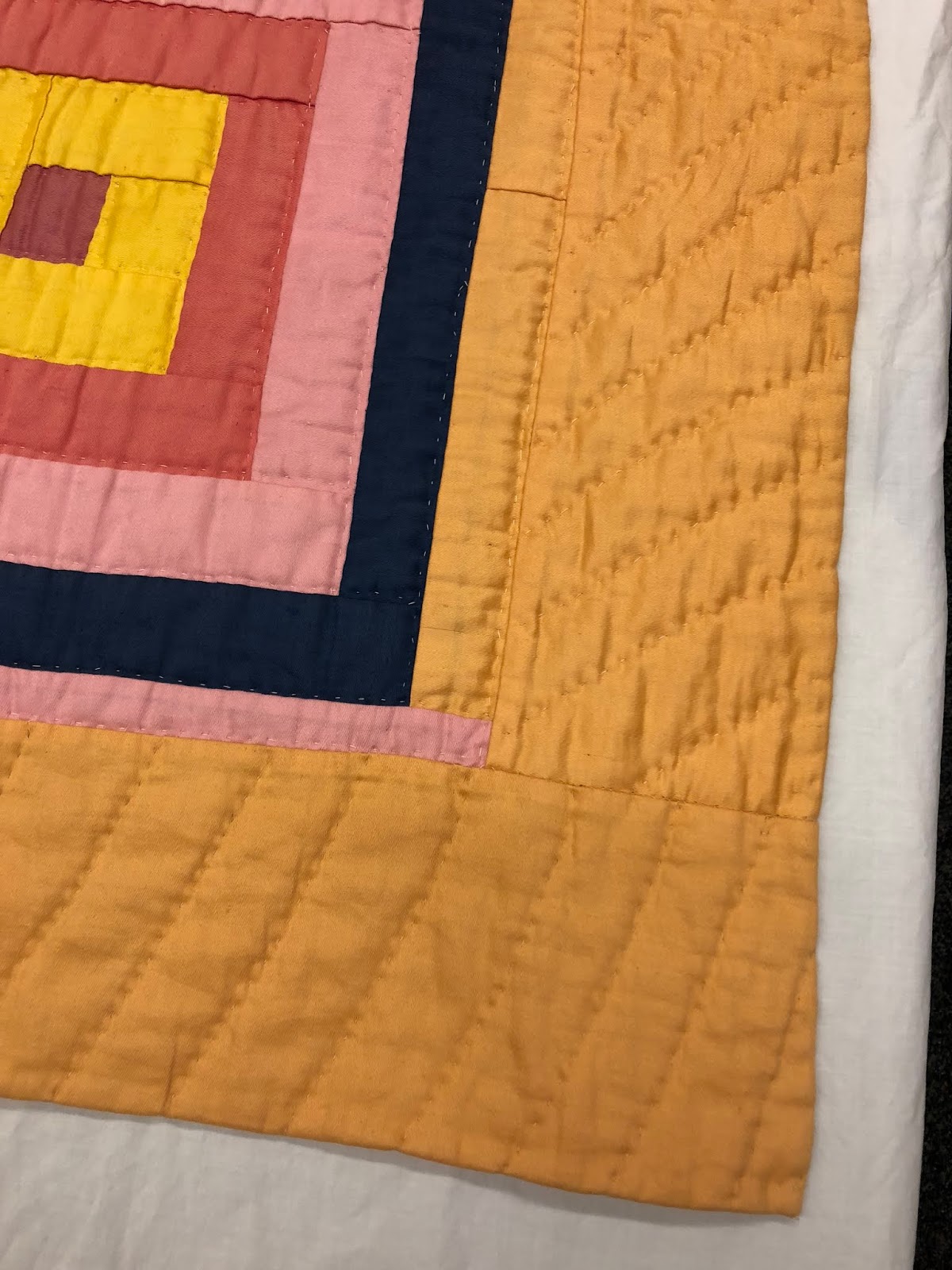
Every two years the American Quilt Study Group hosts a "quilt study" based on a particular theme. the 2018 theme was SOLIDS. I'd remembered seeing this remarkably "modern" quilt at NEQM, so I decided to study it. They are so generous at the museum. They brought it out into their classroom and let me spend hours with the quilt. It is called White House Steps/Checkerboard Variation, maker unknown, circa 1930's.
I mean I was just blown away by this quilt! It was worked in cotton sateen, and the colors really did change based on the lighting in the room, and the position of the viewer.
Such a clash - in an interesting way - of yellows:
Very simple quilting.
I brought a lot of solids to the museum to try to color match as best I could:
Checking that my dark was dark enough:
My palette:
A very improv process and I can't believe I didn't take process photos, or even a final photo! I texted my sister in law photos along the way but those texts are long gone now.
Basting it:
And that's all I have. I called it Jazzy Yellow Checkboard. It was chosen to travel with some of the quilts, to various quilt museums and venues over the next few years. I can't wait for the book to come out so I can see everyone's! Until the quilts are all shown at the yearly Seminar, we are asked to not post any photos or hints on social media, so that the judging can be completely impartial.
As part of the project we write an essay, with a word limit. It's like being back in college with homework, but fun:). Here is the essay I submitted back in May:
I thoroughly enjoyed studying this circa 1930’s log cabin variation at the New England Quilt Museum. What a palette! The addition of lemon yellow to the dominant peachy yellow creates an irresistible, jazzy dissonance. The use of cotton sateen lends a dynamic sheen — are those blues, or purples? It truly depends on the lighting in the room and position of the viewer. The warm yellows and pinks are tempered by muddy khakis and taupes.
Our frugal quilter pieced many of her logs, and used narrow coping strips liberally to get her blocks close enough to measuring fifteen inches square. Blocks are pieced in horizontal rows; the vertical rows are offset by up to an inch in some places. This quilt was not created on a foundation. A casual approach to pressing, and a generous approach to “easing in” resulted in some folds and puckers within the top. Quilting is in (or near) the ditch, with three or four stitches per inch, and the border is quilted in subtly curved lines, an inch apart.
I chose to make nine eight-inch blocks. I matched colors as best I could, and used some shot cottons as a nod to that beautiful sateen lustre. At first, I tried to exactly replicate the piecing of particular blocks, but that plan fell apart as I quickly realized I wanted to experience the attitude of the original quilter - casual, “make do”, and confident. I quickly got into the fun rhythm of improvising. To me, the original quilt is a soulful combination of humble and strong, frugal and free; and I imagine the maker herself embodied those qualities, transitioning from the Jazz Age to the Great Depression.